pH and EC in indoor cultivation: Technical guide to avoid nutrient lockout
Imagine spending a fortune on the best fertilisers on the market, installing state-of-the-art LED lighting and controlling the climate down to the smallest detail. Yet your plants show yellowing leaves, burnt tips or, even worse, stalled growth. The problem is not what you give them, but what they are able to accept.
If the pH is not within the correct range, soil chemistry "hijacks" the nutrients. If the EC is too high, osmotic pressure prevents the root from drawing in water. You are facing nutrient lockout, and in this guide we will break down how to master these variables so that every drop of fertiliser translates into real biomass.
pH: the master key to bioavailability
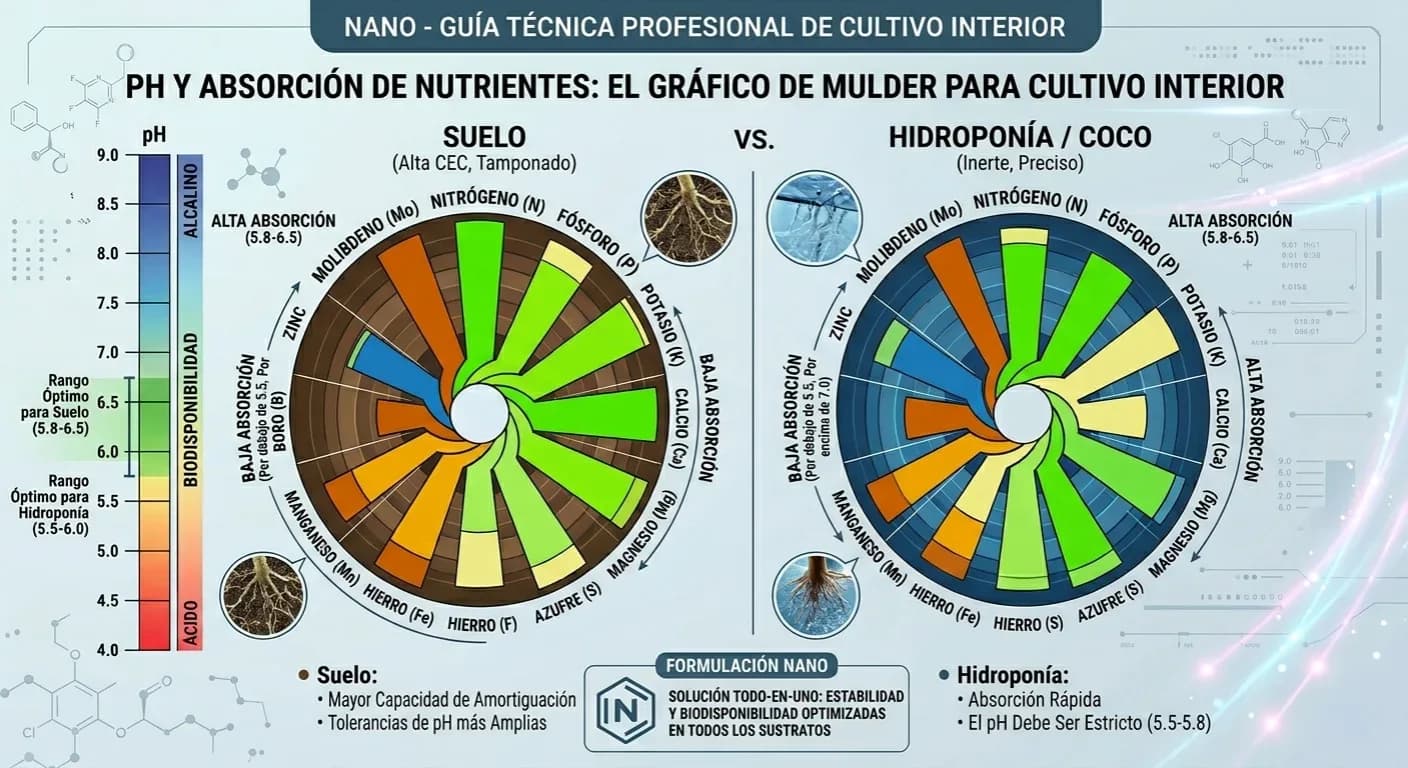
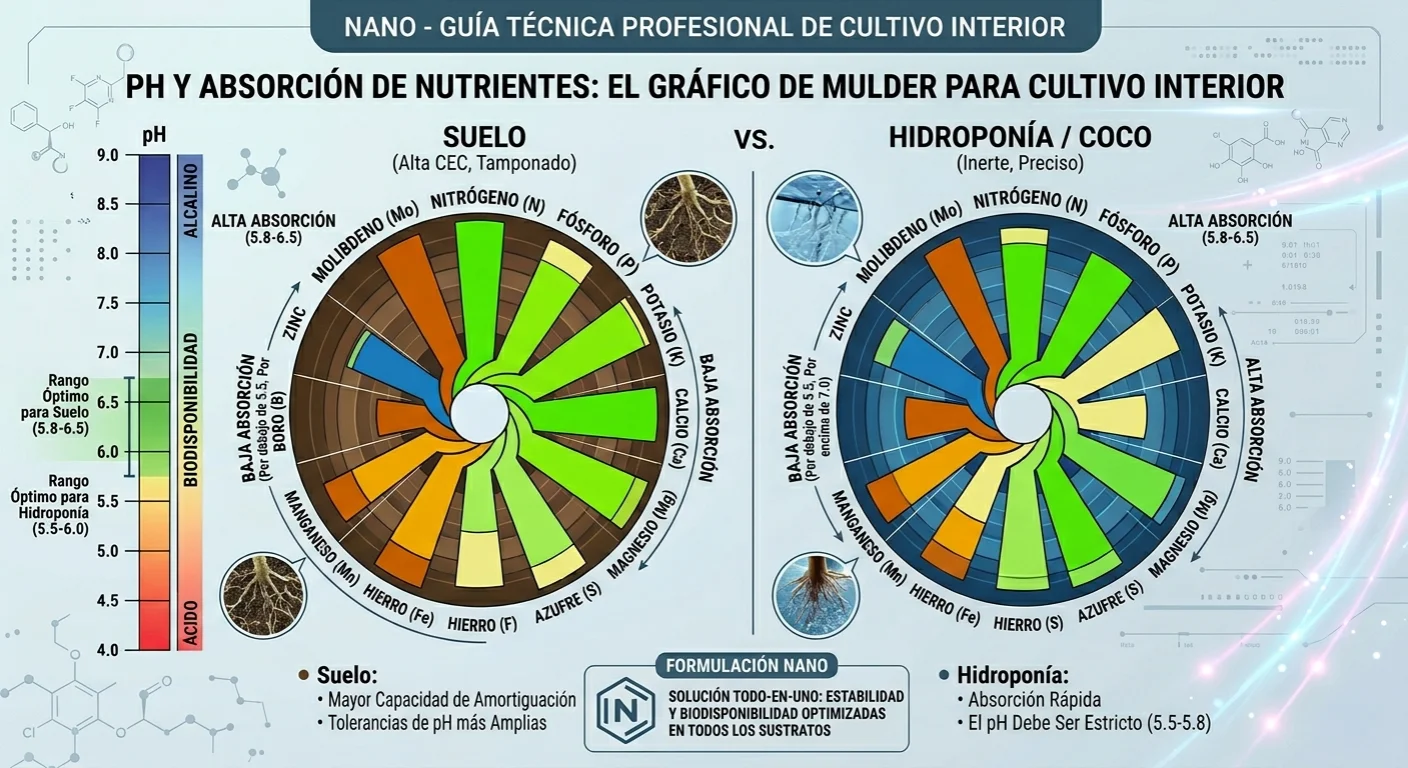
Hydrogen potential (pH) is not just a number; it is the regulator of element solubility. At plant physiology level, the root exchanges ions with the substrate in order to absorb nutrients. If the pH moves outside the optimal ranges (5.5 - 6.5 depending on the medium), critical elements such as Iron or Phosphorus precipitate, becoming solid and unreachable for the plant.
Root-substrate interaction depending on the medium
In soil: The cation exchange capacity (CEC) is higher, offering a "buffer" effect. Here, we aim for a pH of 6.2 to 6.5.
In coco and hydroponics: There is no margin for error. As they are inert media, the pH must remain strictly between 5.5 and 5.8 during the vegetative phase, rising slightly to 6.0 in flowering to favour Potassium uptake.
EC: osmotic pressure and conductivity
Electrical Conductivity (EC) measures the amount of dissolved salts in the water. But be careful: a high EC does not mean a better-fed plant. Under LED systems, where transpiration differs from traditional sodium lighting, managing mineral load is vital.
If you saturate the medium with salts (excessive EC), you generate osmotic stress: the salt concentration outside the root is so high that water leaves the plant and moves into the substrate in an attempt to balance things out. The result: technical dehydration despite having a moist substrate.
Intelligent simplification: Nano’s advantage in water management
One of the biggest challenges for the grower is maintaining the stability of the irrigation solution. Many commercial fertilisers require mixing 5 or 6 products, which pushes EC up and destabilises pH erratically.
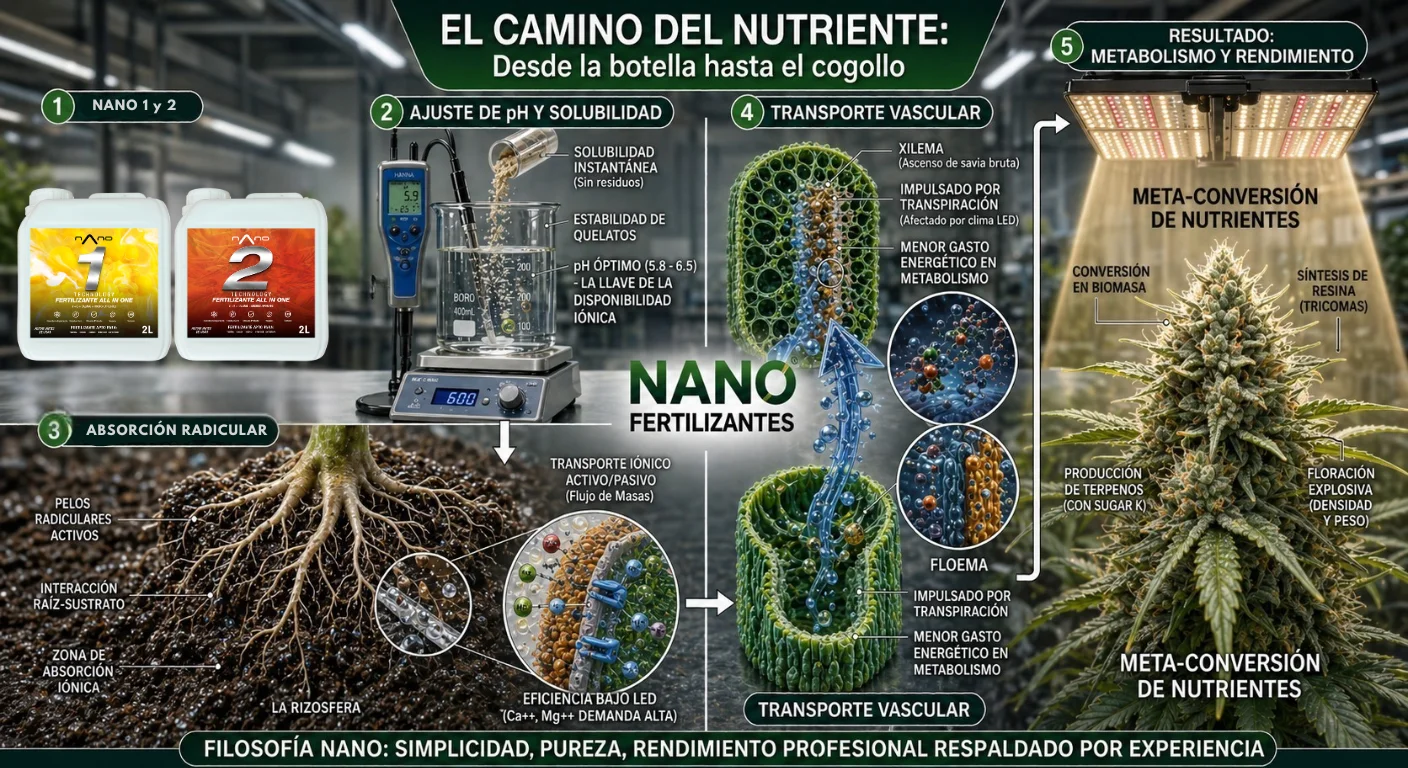
This is where the engineering behind Nano 1 and Nano 2 makes the difference. As All-in-One formulas that integrate A+B, micronutrients and CalMag into a single product, chemical interaction is much more stable.
- Less residue: By using high-purity salts and advanced chelates, the accumulation of unwanted salts in the substrate is minimal.
- Stability: Nano’s formulation helps buffer pH fluctuations, making it easier for the grower to reach the optimal range without excessive use of corrective acids (pH Down/Up), which can damage micro-life in the long term.
How to optimise uptake under LED lighting
LED cultivation reduces leaf temperature, which slows water evaporation. This means the plant "drinks" less, so the nutrient solution must be more efficient.
Using products such as CO2 Effect in combination with controlled EC helps increase the speed of nutrient transport from root to leaves, breaking the assimilation barrier that often occurs in low-transpiration environments.
Quick pH and EC tips
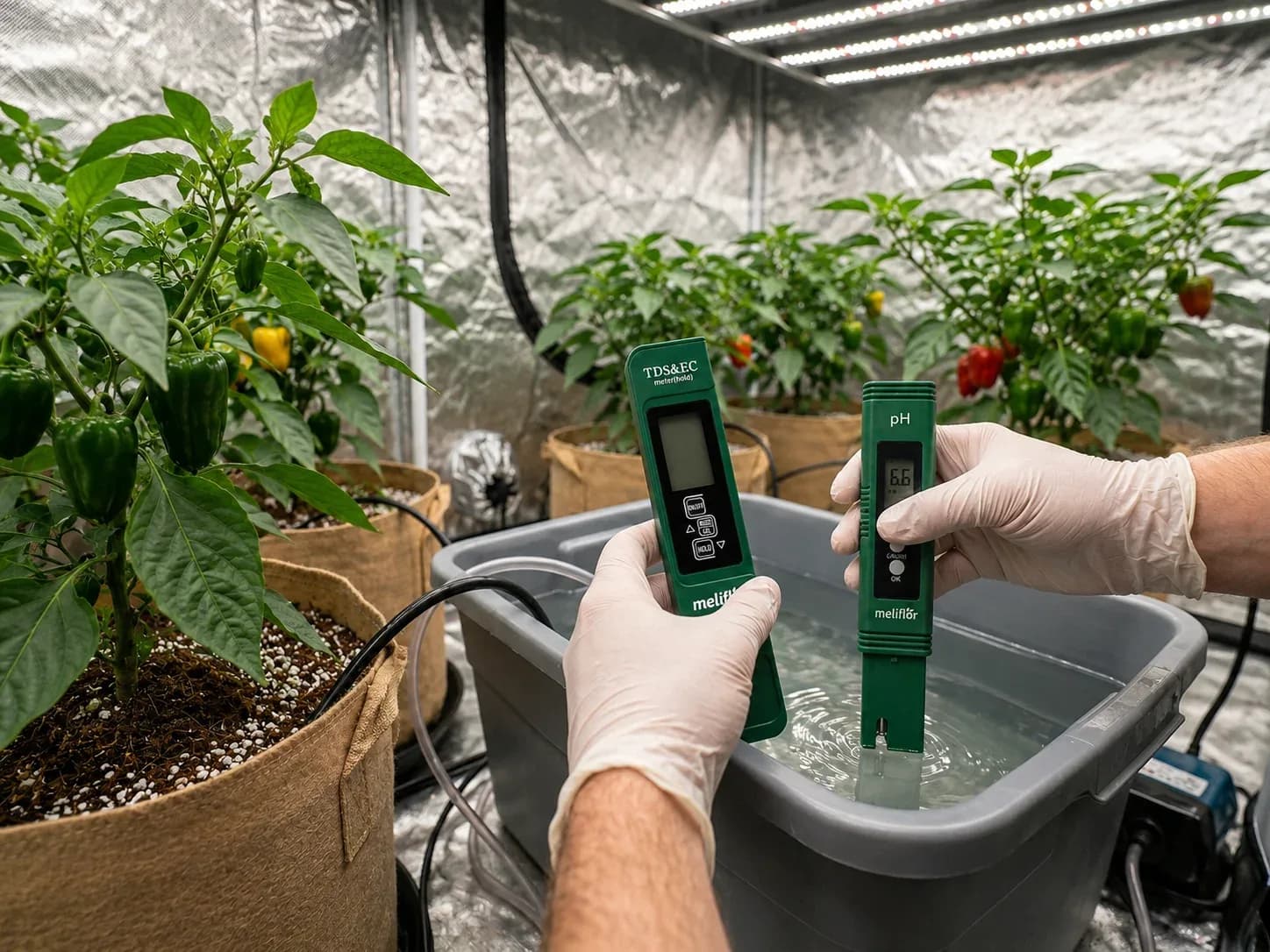
- Always measure after adding fertilisers: With Nano fertilisers, when you have soft-water EC (0.3 to 0.6), the pH usually stays within the normal range. If the EC is high, pH Down is usually used. If it is low (below 0.3), pH Up is normally added. Always measure to make sure which range it is in.
- Check the drainage: If you irrigate with an EC of 1.5 and the water coming out underneath reads 2.5, you have a dangerous salt build-up. It is time to irrigate with water only or with a minimal dose.
- Temperature matters: Calibrate your meters at least once a month and make sure the irrigation water is around 20°C for an accurate reading.
- Mixing order: First add the fertilisers, shake well, and finally adjust the pH. Nano technology is designed to work efficiently after this sequence.
- Do not obsess over one fixed number: It is better for the pH to fluctuate slightly between irrigations (e.g. from 5.8 to 6.2), allowing different microelements to have their maximum absorption "window".