
Real Bud Fattening: What Actually Works and What's Pure Marketing
The bud-fattening booster market is one of the most saturated in indoor growing. There are dozens of products promising explosive flowers, extreme density, and weight gains that border on implausible. Most of them share something in common: an eye-catching package, an aggressive name, and very little real information about what's actually inside.
The question you should ask before opening any fattening product isn't whether it works. It's what exactly it does, why it does it, and at what point in the cycle it makes sense to use it. Without that foundation, you're spending money blind.
In this post we're going to separate what has real physiological backing from what's pure marketing. And we'll look at how to structure the fattening phase so that every product you add to the water has a specific reason to be there.
What a Flower Actually Needs to Fatten Up
Fattening isn't some mysterious process. It's plant chemistry with clear rules. For a flower to gain real density and weight, the plant needs three things working at the same time:
- 1.Enough phosphorus and potassium available at the root.
- 2.Efficient photosynthesis that generates the sugars needed to build mass.
- 3.An internal transport system that carries those resources from the leaves to the flowering sites.
If any of those three points fails, it doesn't matter how much fertilizer you add. The flower won't respond, because the limitation isn't nutritional — it's functional. And this is where many growers make the mistake of continuing to raise doses when what they actually need is to fix the bottleneck, not add more pressure to the system.
⚠️The most common fattening mistake Pushing EC above what the substrate can handle in search of bigger flowers. The result is the opposite: salt buildup, absorption lockout, and flowers that stay small with a compacted look. More EC doesn't equal more fattening. It equals more risk.
What Sets a Real Booster Apart from a Marketing One
A fattening booster with real substance has to demonstrably do at least one of these things:
- 1.Supply phosphorus and potassium in highly assimilable forms that directly feed the building of floral mass.
- 2.Activate physiological mechanisms that improve photosynthetic efficiency or nutrient transport.
- 3.Provide bioactive compounds the plant can use directly as synthesis precursors.
What has no real basis is any product that promises results without explaining the mechanism. A booster that only contains simple sugars with no additional functional component isn't feeding the flower: it's feeding the microorganisms in the substrate.
It can have indirect effects in soil with good microbial life, but it isn't direct fattening.

How We Approach Fattening with the Nano Range
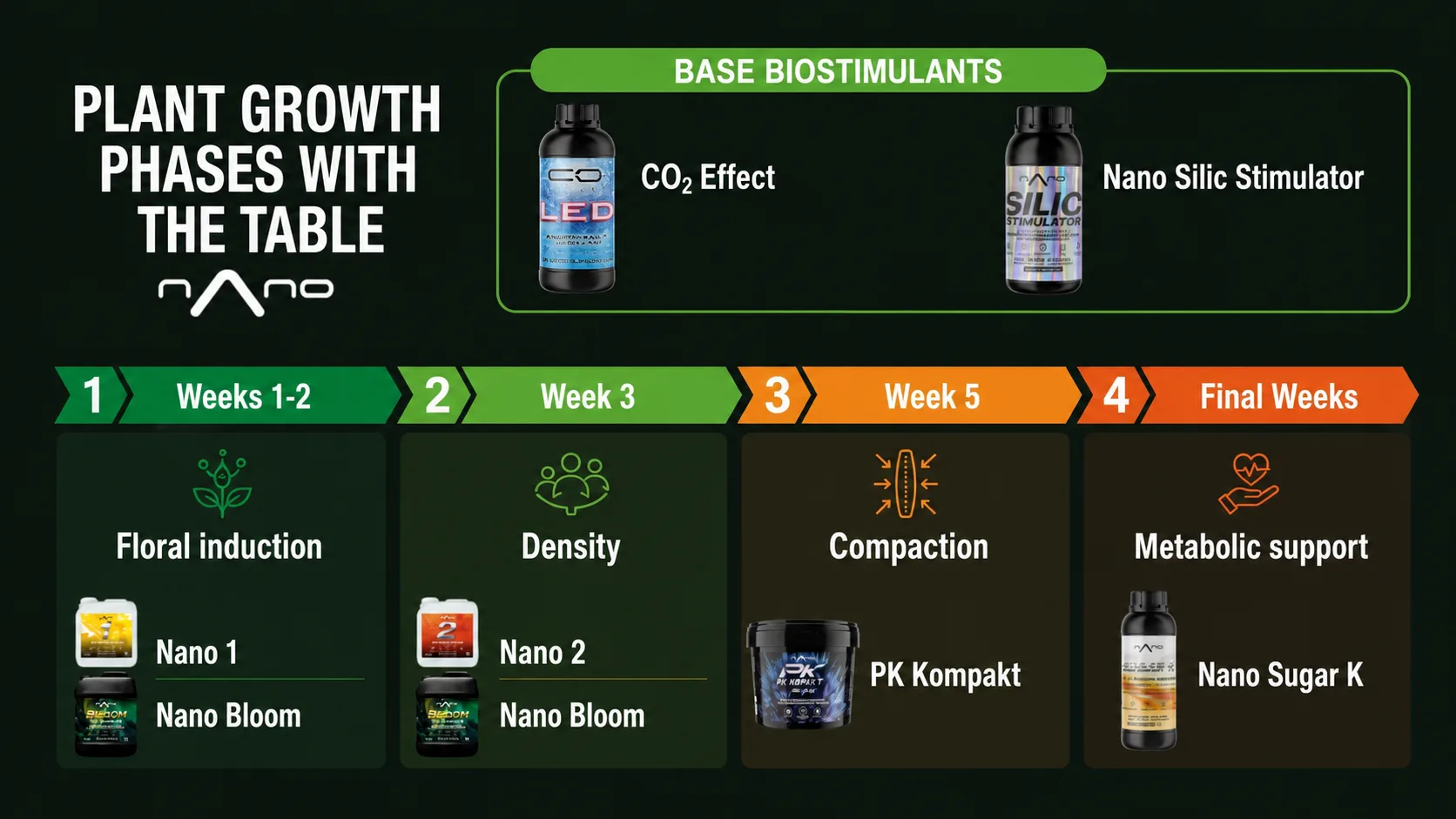
The fattening phase in Nano is built on three products with distinct, complementary roles: Nano Bloom, PK Kompakt, and Sugar K. None of the three does the same thing. And that's exactly the point.
- NANO BLOOM: the base stimulator from week 3 onward. It isn't a finisher — it's the piece that prepares the flower for real fattening. Its PK 14-15 profile comes with a complex of bioactive compounds that make the difference: laminarin and fucoidan from algae extracts, which activate defense mechanisms in the rhizosphere and strengthen the cell wall; alginic acid, which improves substrate microbial activity and root growth; and essential amino acids and natural phytohormones that optimize macronutrient uptake.
The end result is similar to what you'd get with synthetic phytohormones, but with a naturally derived composition that works at lower doses.
As a root drench💧it's applied from week 3 of flowering alongside Nano 2.
As a foliar spray🚿 — 1–2 ml/L with the lights off, once a week, it creates an anti-transpirant layer over the chlorophyll that protects the crop under high light intensity and delivers an extra dose of phosphorus and potassium directly to the leaf.
- PK KOMPAKT 20-45: the structure finisher. It comes in from week 5 onward, once the bud already has its defined shape and the goal is to compact it and increase density. It's a concentrated solid fertilizer with 20% phosphorus pentoxide and 45% potassium oxide.
Those numbers aren't marketing: they're the reason it acts directly on the bud's homogeneity and consistency in the final phase.
The dose is low precisely because the concentration is high: 0.5 g/L as a root drench💧from week 5 through the last week before harvest. Don't raise it. With soft or hard water, the adjustment is made on the solution's total EC, not on this product's dose.
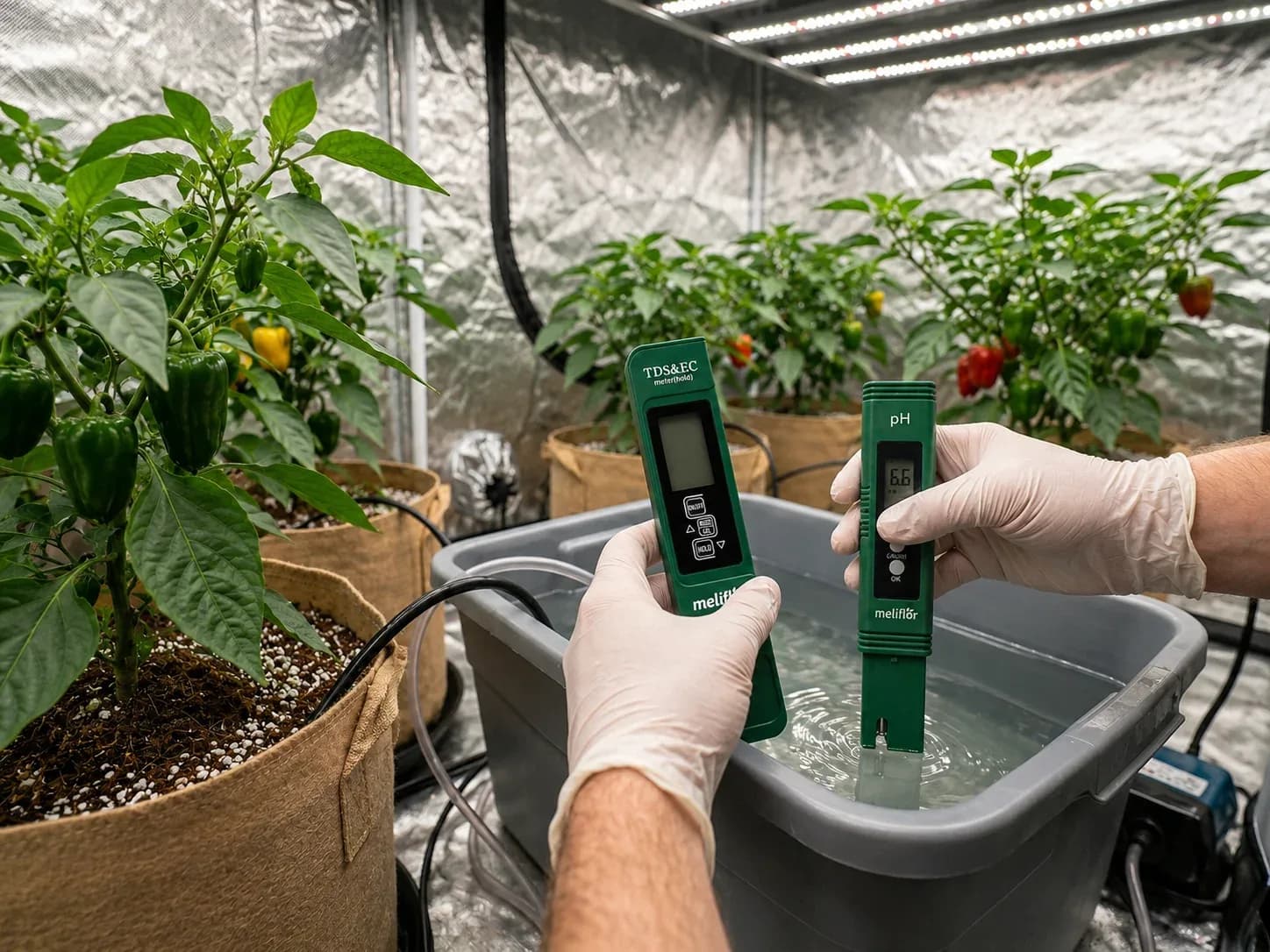
💡PK Kompakt in practice When adding PK Kompakt to your solution, remember its concentration is high and it raises EC noticeably with very little volume. Always mix it into the water before adding the rest of the products, and check the final EC before watering. The maximum EC recommended in the Nano chart for this phase is 3.0 mS.
- SUGAR K: the metabolic finisher for LED grows. Sugar K comes in during the last two weeks of the cycle and has a different role than the other two. It doesn't mainly supply structural PK: it supplies 11% potassium (K) along with a profile of compounds that activate the plant's metabolism in the final stretch.
Glucose, essential amino acids, natural phytohormones, fulvic acids, mannitol as an osmo-protectant, carbohydrates, and vitamins.
All of that serves one specific purpose: getting the plant to convert water and nutrients into heavy mass and minimize weight loss during drying.
It's specifically designed for LED cultivation. Plants under LED have high metabolic and enzymatic activity but lower water consumption. Sugar K boosts that efficiency at the exact moment the plant is closing out its cycle and building up reserves. The result shows up on the scale: less weight loss during drying.
The Sequence That Makes Sense
Fattening isn't a sprint, it's a progression. Every product has its usage window and its role within that window. Using all of them from the start doesn't speed up the process — it saturates it.
🧠 Grower's tip Real fattening starts long before week 5. It starts in week 1, with a clean nutritional transition, a substrate free of salt buildup, and controlled EC. A flower that reaches week 5 with a blocked root system won't respond to any finisher, no matter how good it is. The foundation always comes first.
Quick Fattening Tips
- Nano Bloom from week 1, not before: the plant needs its floral sites already formed to make use of the bioactive stimulus. Before that week, the product has nowhere to act.
- PK Kompakt at low, steady doses: the concentration is high. Stick to the 0.5 g/L dose and don't raise it looking for more effect. The quality of the product does the work, not the quantity.
- Sugar K only in the last two weeks: it's a finisher, not a mid-flowering fattening booster. Using it earlier doesn't speed up results and takes up the EC headroom you need for Nano 2 and PK Kompakt. You'll get more aroma and flavor, plus it optimizes the flower's drying, gaining you more than 20% extra yield.
- Apply CO2 Effect as a foliar spray with the lights off through week 3 of flowering: once a week is enough. More frequent applications don't improve the result and can leave residue on the buds.
- Always measure the final EC after mixing: with three products in the solution, EC builds up in layers. Add each product separately and check the EC before moving on to the next one.
- Don't confuse a big flower with a quality flower: the goal is density, dry weight, and final quality. A fluffy, large flower weighs less dry than one that's compact and smaller. Real weight is made during drying.
If you're using Nano Bloom, PK Kompakt, and Sugar K, download the official fertilization charts at nanofertilizantes.com.