Flowering Nutrition: How to Bulk Up Buds Without Burning the Plant
How Can You Bulk Up Buds Without Burning the Plant?
You switch the timer to 12/12, spot the first white hairs and your initial reaction is to open the flowering fertiliser and increase the dose. Logical, right? The plant is producing, so it needs more nutrients. The problem is that, at this point, the plant is not producing yet. It is reorganising itself.
If you hit it with a high EC and too much phosphorus too early, all you will achieve is blocking the plant precisely when you need it to be most active.
Flowering does not begin when you change the timer. It begins once the plant has finished processing that change. This difference may seem small, but it affects everything.
What Happens Inside the Plant When Flowering Begins?
When the plant receives the photoperiod signal, it activates a hormonal cascade that redirects its resources towards reproduction. It stops prioritising vegetative growth and begins developing flowering sites. During this process, phosphorus demand rises sharply because it is a key nutrient for cell division in new plant tissue.
However, there is an important detail: during the first 7 to 10 days of flowering, the plant is still stretching the spaces between the stem nodes and building its structure. Nitrogen levels need to decrease, but nitrogen should not disappear completely. An overly abrupt nutritional transition at this stage causes just as much stress as overfeeding.
At root level, any salt buildup left over from the vegetative cycle now becomes a much bigger problem. The nutrient absorption system is operating close to its maximum capacity, and a high EC in the growing medium directly blocks the uptake of phosphorus and potassium, the two macronutrients the plant needs most during this phase.
⚠️ Warning sign If the leaves around the developing flowers are very dark green, almost black, at the beginning of flowering, there is too much nitrogen in the system. The buds will still form, but they will remain soft and take longer to become dense.
The Most Expensive Mistake: Confusing Intensity with Efficiency
The idea that more fertiliser during flowering means more buds is widespread. It is also one of the mistakes that ruins the most harvests.
When you increase EC suddenly at the beginning of flowering, salts build up in the growing medium faster than the plant can absorb them. The visible results are burnt leaf tips, leaves curling upwards and buds that never fully compact. However, the real problem is invisible: the roots are working against excessively high osmotic pressure and are no longer absorbing the nutrients the plant actually needs.
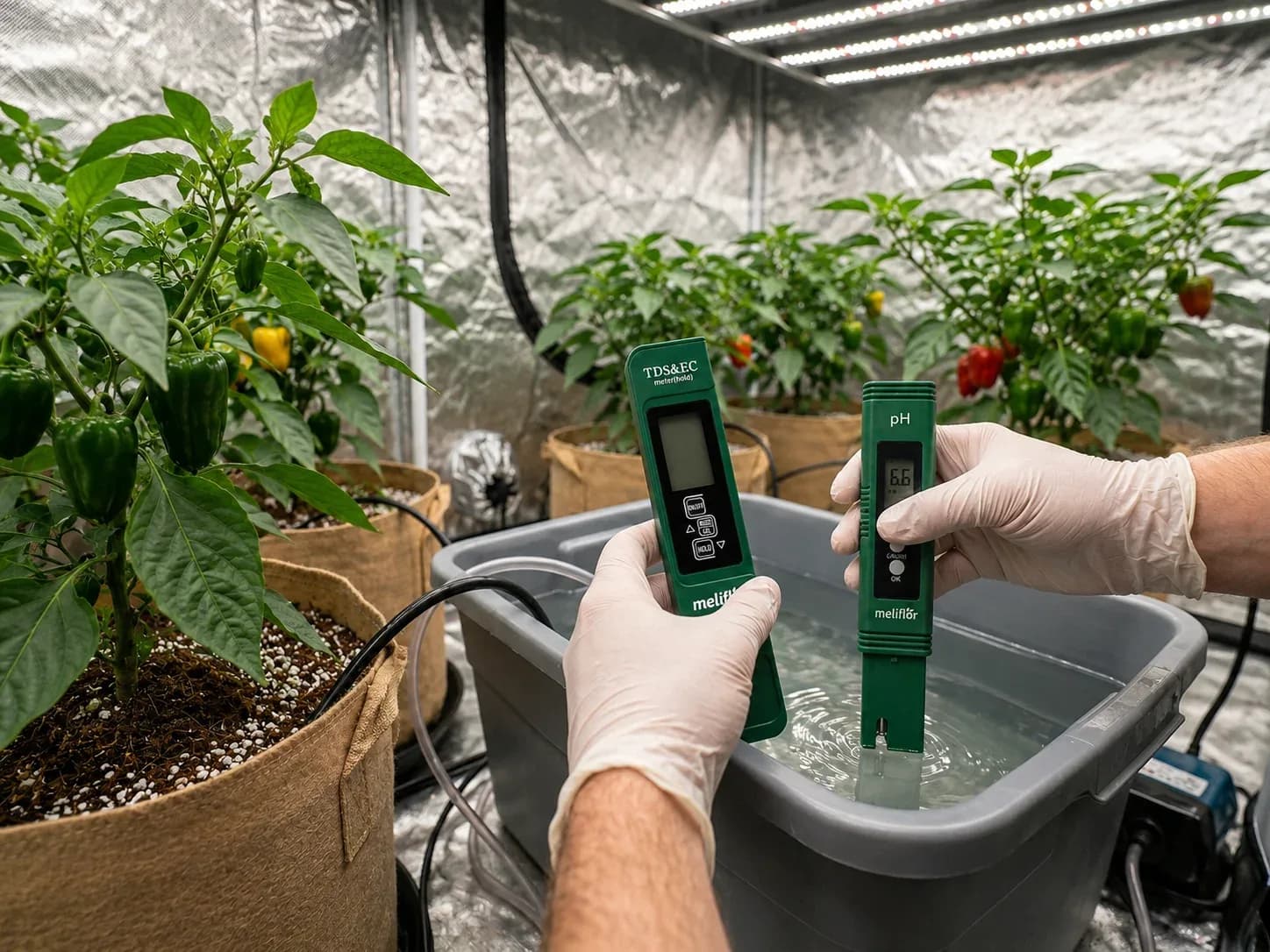
This effect is amplified in LED grows. Plants grown under LED lighting transpire less than plants grown under HPS lighting, which means the growing medium concentrates nutrients more quickly at the same dose. The simplest way to detect this is by measuring runoff EC. If it is more than 0.5 mS above the input EC, salts are accumulating. At that point, no booster will work because the roots cannot absorb nutrients efficiently.
Week by Week: How Nutritional Demand Changes
Weeks 1–2: The Transition
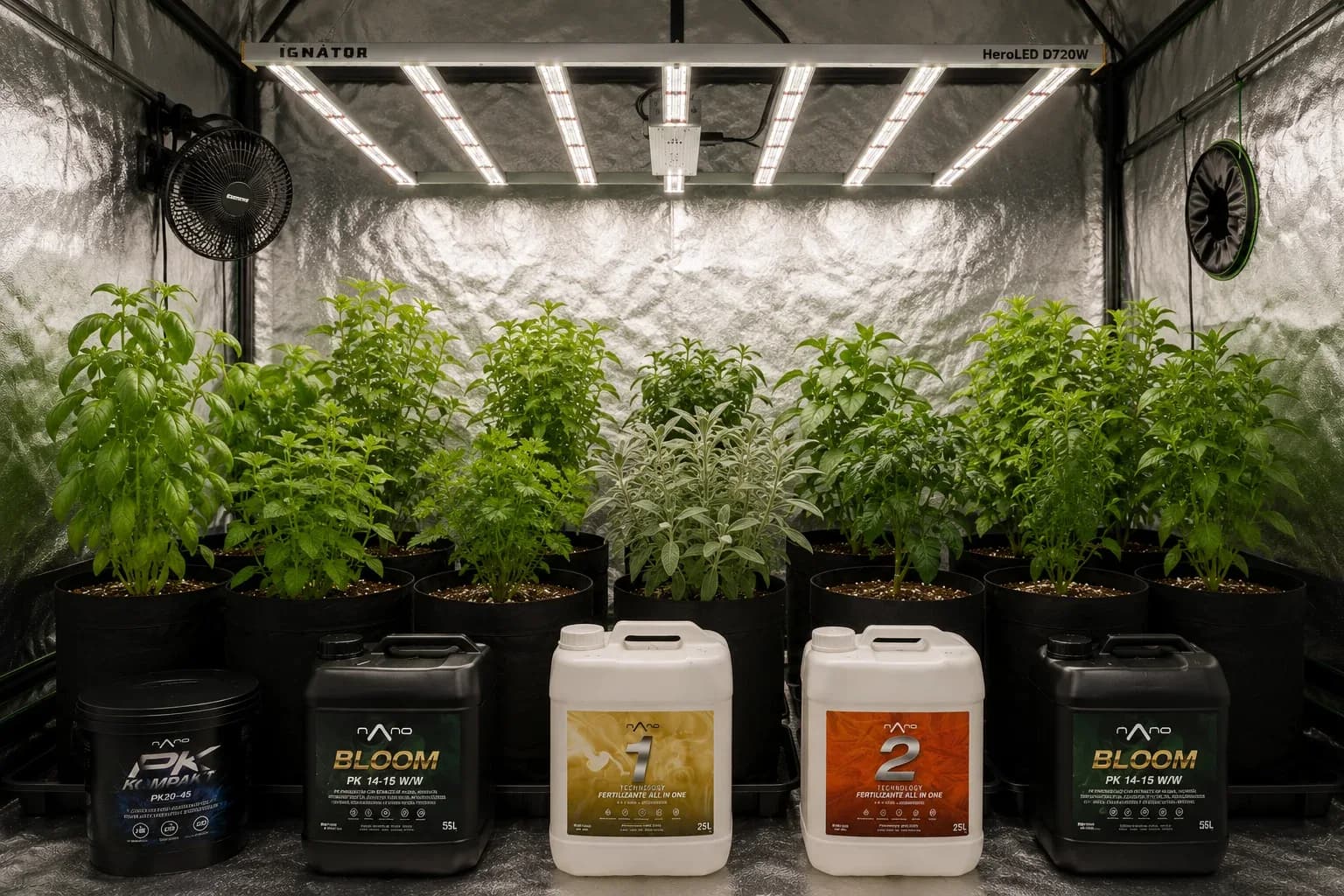
The plant is still reorganising itself. This is the time to encourage flowering with Nano Bloom, introducing it gradually rather than all at once.
- For soft water, the Nano feeding chart recommends 0.5 ml/L of Nano Bloom during weeks 1–2, with a maximum recommended EC of 2.6 mS.
- For hard water, this phase begins with the same dose: 0.5 ml/L, with an EC of 2.7 mS.
The Nano 1 profile already manages the transition. Depending on the feeding chart you use, the amount of Nano 1 varies to keep the macronutrients properly balanced. You do not need to mix in anything else to obtain a complete nutrient solution.
Weeks 3–4: Active Bulking
The flowering sites are now established, and all the plant's energy is directed towards producing mass.
- Soft water: use Nano 2 at 8 ml/L.
- Hard water: use Nano 2 at 7 ml/L, with a maximum EC of 2.8 mS.
This is also the time to increase the Nano Bloom dose to 1 ml/L in the irrigation solution.
Its PK 14-15 profile, together with its complex of bioactive compounds — amino acids, natural phytohormones and seaweed extracts — improves nutrient uptake and produces denser flowers without having to force EC levels.
💬 Remember that every millilitre of Nano Bloom increases the conductivity of the solution by 310 µS, allowing for very precise adjustment.
From Week 5 Until Two Weeks Before Harvest: Maximum Production
EC reaches its highest level: 3.0 mS, according to the official feeding charts. Nano 2 remains at 7 ml/L, while Nano Bloom stays at 1 ml/L.
This is also when PK Kompakt is introduced at 0.5 gr/L. This solid finishing product rounds off bud compaction during the final weeks of active bulking.
Second-to-Last Week: Gradual Reduction
EC is reduced to 2.7 mS. Nano 2 is lowered to 5 ml/L, while Nano Bloom is reduced to 0.5 ml/L.
Sugar K is also introduced at 2 ml/L to achieve outstanding final quality by improving aroma and flavour and optimising the drying process.
The plant begins moving resources from the leaves towards the flowers. Yellowing of the lower leaves at this stage is not a deficiency; it is a physiological process. Do not rush to add more fertiliser.
Final Week: The Flush
EC is reduced to 1.7 mS. Nano 2 and Nano Bloom are removed from the feeding programme.
Only Silic Stimulator at 0.5 ml/L and Sugar K at 2 ml/L are maintained.
Growing Under LED Lighting
Plants grown under LED lighting consume less water, causing nutrients to become concentrated in the growing medium more quickly than under HPS lighting.
Always use the Nano feeding chart doses as your starting point and make adjustments according to runoff EC, not just input EC.
In hydroponic systems, the recommended maximum EC levels are slightly higher, reaching up to 3.0 mS during weeks 3–4.
Quick Flowering Tips
- Do not change fertiliser on the same day you change the timer: wait until the first flowering sites appear before completing the transition to Nano 2.
- Adjust pH according to the growing medium: maintain 6.0 to 6.4 in soil and 5.8 to 6.2 in coco. A pH outside the correct range can block phosphorus uptake even when phosphorus is present in the nutrient solution.
- Introduce Nano Bloom during week 1, not before. The plant needs established flowering sites before it can use it effectively.
- When growing under LED lighting, monitor salt buildup carefully. Lower transpiration causes nutrients to become concentrated in the growing medium faster than under HPS lighting.
- Yellowing at the end of flowering is not necessarily a deficiency: when it appears on lower leaves during week 6 or 7, the plant is redistributing its resources. Let it do its job.
If you use the Nano range, download the official feeding charts from nanofertilizantes.com. Specific charts are available for soft water, hard water and hydroponic cultivation, with exact weekly doses for each product. The EC calculator helps you make accurate adjustments without having to perform the calculations manually.